






















These are more complicated questions than they seem.
The ever-increasing volume of VOD content and the need for daily asset checks and reviews create challenges for content providers, not to mention the need for visibility across the entire video delivery chain.
According to recent data from Canoe Ventures, which “performs service assurance for video on demand (VOD) dynamic ad insertion (DAI) on multiple video platforms including set-top-box, IP, and mobile across its 38 million US household[s],” ad views on VOD content within their ecosystems have grown from 6.3 billion in 2014 to over 26 billion in 2020.
These are big numbers but they only tell part of the VOD story.
A report from Fortune Business Insights places the dollar value of the global VOD business at just under $54 billion, with growth projected to almost $160 billion by 2027 and the US market valued at nearly $20 billion in 2019. Based on growth rate estimates of 14% for 2020 and 2021 of 14% held fast for 2020 and 2021, that puts the current US VOD market (aVOD, sVOD and tVOD combined) at somewhere around the $26 billion mark. I suspect this number may be conservative given the impact of Covid-19 on entertainment habits in the US and globally.
In fact, the report was prescient in its assertion in 2019 that a decrease in window between theatrical release of a movie and its availability on an SVOD service was likely to “influence the consumer’s preference for VOD platforms.

Nowhere is this more apparent than at HBO Max. After a rough launch, which saw the notable absence of the service on platforms like Roku and Amazon, HBO Max found its legs and started running, playing catchup to the big players, Disney+ and Netflix. After WarnerMedia announced its controversial movie release strategy of same day theater and in-home availability, the HBO Max app saw an increase in subscriber growth and cracked the Top 10 list for app downloads in 2021, “the only major streamer to do so.” While app downloads do not present a complete picture, this is at least a directional indicator of the growing success of the service in a market dramatically impacted by a global pandemic.
Even with a projected leveling-off of subscriber growth rate, and a decline in traditional cable subscriptions, overall subscriptions are expected to grow long-term, and VOD consumption in general is set to expand, regardless of the potential service consolidation looming on the horizon.
In fact, Digital TV Research sees total SVOD subscriptions reaching 450 million by 2026, with the average household paying for 4 or more platforms. Additionally, according to the “Global Video-on-demand (VOD) Market 2021-2025” report, the global VOD market is set to grow by $162 billion between 2021 and 2025, with one major driver being consumption on mobile devices.
So what does this mean for content providers, service owners, and platform operators?
It means more content on more devices in an ever-more competitive market with a rapidly evolving technical ecosystem. It means greater opportunity with equally greater challenges.
The opportunity is obvious - revenue growth through ad impressions, subscriber growth and, to some extent, growth in transactional VOD
The challenges are multifaceted but for purposes of this discussion let’s lump them into two categories - Quality of Service (QoS) and Quality of Experience (QoE). Ramiro Nobre with Accedian, in a blog post from 2020, opens with an excellent example of the difference between these two measures of quality.
The challenges are multifaceted but for purposes of this discussion let’s lump them into two categories - Quality of Service (QoS) and Quality of Experience (QoE). Ramiro Nobre with Accedian, in a blog post from 2020, opens with an excellent example of the difference between these two measures of quality.
"
The difference between quality of service and quality of experience is immediately clear during a videoconference that garbles words or pixelates a PowerPoint slide to the point of illegibility. The video transmission might technically hit quality of service level agreement minimums over the span of the call, but the overall experience still is an epic fail. This is the difference between Quality of Experience (QoE) and Quality of Service (QoS).
While he’s referring to network performance metrics, for the VOD space we can use this as a model. For example, while a service provider might be meeting the terms of their SLA with a content provider, those terms may not necessarily ensure a high QoE for consumers, especially when it comes to on-time delivery of content to the consumer.
Consider the volume of content being delivered to VOD services today.
According to Mordor Intelligence, “The main reason behind the surge in the popularity of OTT streaming platforms is the growing demand for unlimited access to original and high-quality content.”
Think about that for a minute. If the major factor in the continued growth of the market is an increasing demand for content, then it makes sense that content providers will continue to grow their available catalogues, either through new content (e.g. “The Wheel of Time”) or the revival of existing content (e.g. “Friends”) in the VOD space.
While most content carries some form of license window, meaning it won’t live on a service or platform forever, this still indicates a growth in volume of content delivered across all content providers and VOD services.
As a content provider, how do you know your content is reaching your consumers on time, and in the format, with the metadata, in the location you expect? (QoS)
And if it isn’t, how are your viewers impacted (QoE)? One impact is diminished find-ability, and if your viewers can’t find your content, you can’t monetize it effectively.
Pick any tent-pole initiative or high-profile program, “Yellowstone,” “Game of Thrones,” you name it, content that has multiple paths to follow on its journey from provider to viewer. How do content providers know whether or not the asset arrived at its destination? In many case, they don’t know unless someone reports a problem.
In other words, a viewer complained.
This is true for other key aspects of the viewing experience. For example, is the asset playable on all platforms to which it was delivered? If it’s not, how long does it take a content provider to become aware of the problem and, more importantly, to fix it? The second can’t happen without the first. Is this a task you, as a content provider, want to trust to just anyone?And what about license windows? Does the content availability respect the C3, D4 and Day & Date windows? If not, there’s even more at stake if contractual obligations are not being met.
What about the artwork and metadata? It’s not enough to have correct metadata, content providers want their assets to display the artwork and metadata they delivered in the VOD package. This is not always the case as some services choose to present art, images, and descriptive metadata derived from third-party providers, like Gracenote.
Not all networks will be OK with “clean” images, those that do not carry the network’s logo. Yet some OTT services and even traditional MVPDs prefer art without a network bug. Viewers might be confused as well - did the episode of “Big Bang Theory” they’re watching come from TBS or CBS? I think most content providers would agree, this matters.
Metadata mismatches can happen the same way. If a program, let’s say a 30 minute episode of a kids cartoon (because not all cartoons are for kids these days) was split into two 15 minute episodes and delivered as two separate VOD assets, what descriptive metadata will appear for each of them if the streaming service uses third-party metadata?
Which brings us back to the question - how do you, as the content provider, know when this happens? This question is, or should be, just as important for streaming service operators.
Which brings us back to the question - how do you, as the content provider, know when this happens? This question is, or should be, just as important for streaming service operators.
In some cases, at least from my experience on the content side of the business, the first viewers to report a problem are employees of the content provider - people in programming or marketing who know exactly when and where their show is supposed to be at any given moment, and how it should, from their perspective, be presented.
Is this ad hoc method any way to monitor your VOD assets? Obviously it’s not efficient, but for many content providers, human reporting via limited content consumption is the only method available. The larger the content library, the more fraught with risk this becomes. Rapid delivery cadence can be a force-multiplier for these issues too.
But there is a better way, and it starts with AI and automation in the cloud.
This is where eDigital comes in.
VOD Monitoring, the Smart Way.
As a content provider, you could have thousands of assets available across multiple services, platforms and devices, each of which increases the difficulty in keeping track of your content and ensuring on-time and accurate availability, find-ability and playability.
With it’s AI driven cloud-based VOD monitoring capabilities, eDigital empowers content providers to track their assets through delivery to availability and play-out. This includes the validation of content placement (e.g. Category) as well as validation of its metadata and artwork, across multiple services and devices, all without a single on-premises device.
In other words, with regard to your VOD content, you can know where it is, when it got there, how it looks, and how it plays, across multiple platforms and devices, without waiting for viewers to report a problem, or relying on manual checks on limited devices and services. And you can gather this data across your entire catalogue of delivered content, in real-time.
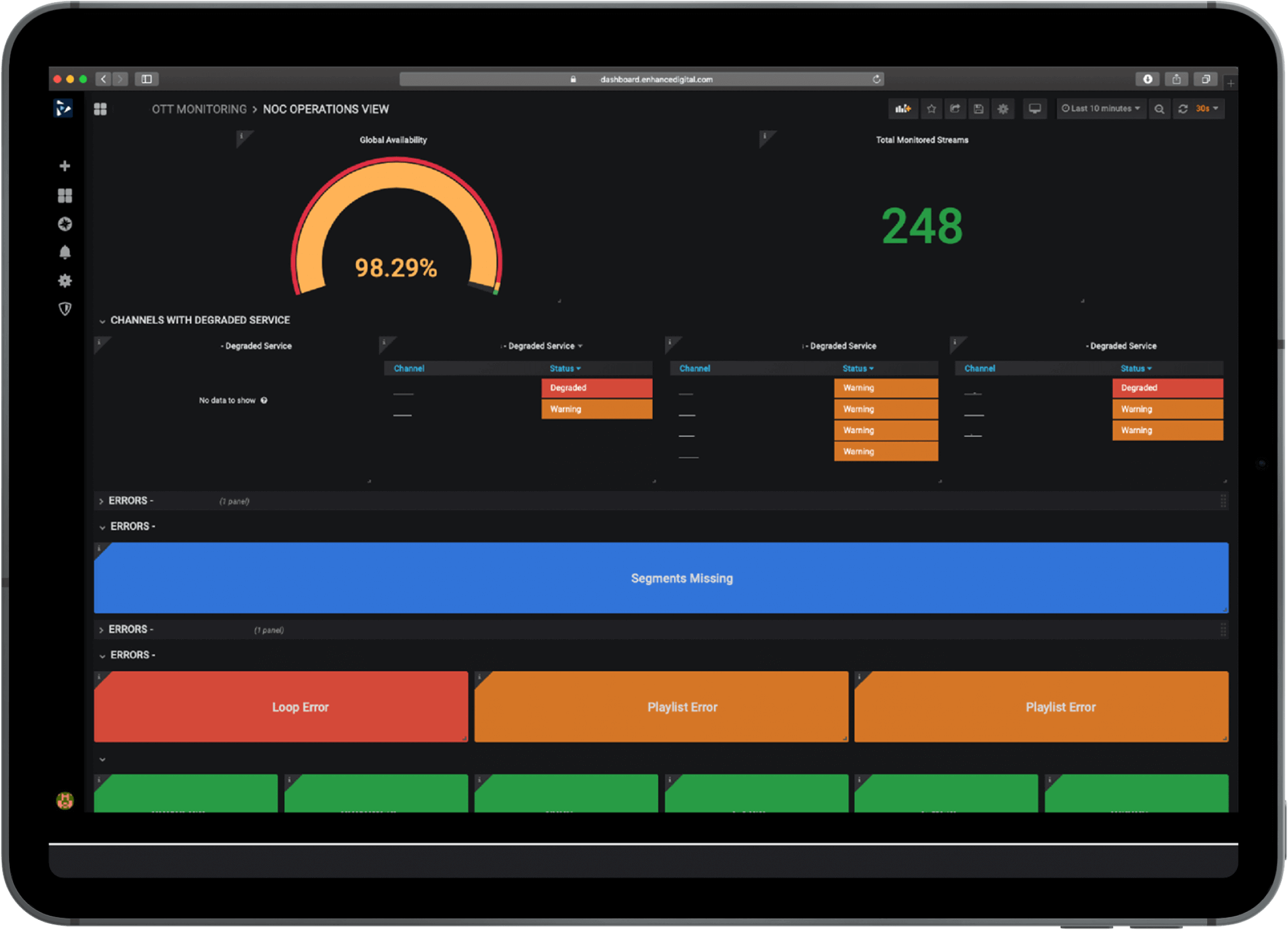
eDigital’s VODSmart.ai SaaS provides expansive data sets about a provider’s consumer-facing library, rolled up into a highly customizable dashboard.
Want to know if that latest episode of your top premium TV series is available on any given streaming app when it is supposed to be there? VODSmart.ai can deliver that data for every asset in your offering, not just your high-profile assets, when you need it most.
Want to know whether or not those assets are playable? VODSmart.ai can deliver that data as well, with rapid checks and screen grabs of any issues found.
Want to know if the metadata on a given platform matches the metadata you think you delivered? VODSmart.ai can tell you that too, and can highlight discrepancies in your dashboard. The same is true for asset artwork.
And what about that QoS question? VODSmart.ai can provide the data you need in order to address delivery failures or delays with your vendors and affiliates. That’s SLA accountability on a daily basis.
Powerful data, delivered by eDigital’s VODSmart.ai SaaS, without having a single device on premises.
Because if an asset isn’t available on time, has incorrect metadata, or doesn’t play when the consumer wants it, that’s a bad QoE for your viewers and a direct hit to your bottomline.
Get out in front of problems, remediate delivery issues, and build a better, more reliable experience for your viewers through automated cloud-based VOD monitoring from eDigital.
Get out in front of problems, remediate delivery issues, and build a better, more reliable experience for your viewers through automated cloud-based VOD monitoring from eDigital.
Ready for the World?
VODSmart.ai supports US and International media services, right out of the box. When you’re ready for international expansion, VODSmart.ai is ready too, with the scale you need wherever your content is delivered. VODSmart.ai is like having users and devices in the markets you’ve targeted for expansion, working 24/7 to analyze and report on all of your content across multiple devices, services and platforms.
Let’s take a look at how this works.
VODSmart.ai is a cloud-first offering, with embedded machine learning accessing a farm of real OTT and streaming devices. Regularly timed automated sweeps of your content are conducted based on your requirements, and the results are delivered to a dashboard you can customize, or eDigital can customize on your behalf. This delivers a broad overview of the health of your consumer-facing content while enabling faster daily checks of your most important initiatives. It’s the perfect complement to your existing monitoring workflows, or eDigital can help you build a robust stand-alone VOD monitoring process. Whatever you choose, VODSmart.ai can deliver the data you need right when you need it.
Speaking of devices, eDigital’s device farm can scale to suit your needs and perform the necessary content sweeps based on the number of assets to be checked, and you won’t have to buy or host a single device. Once your account is configured, it can be as simple as logging in, choosing your devices and media services, and you can start monitoring your VOD content availability, playability and integrity. Coupled with exceptional support, available webinars and training opportunities, you’ll be up and running in no time. And if eDigital doesn’t have the device or platform you need to monitor, it can be added in less than 48 hours.
In short, eDigital’s VODSmart.ai is a robust, scalable, cloud-based system for delivering accurate and actionable data via customizable dashboards giving content providers immediate access to a rich and expansive dataset for rapid and consistent automated VOD asset monitoring. And eDigital’s analytic modules can deliver powerful insights regarding your assets and broader market trends.
And if that’s not enough for you, just imagine what eDigital can deliver in terms of competitive analysis. Because if you can monitor your own VOD content, why not monitor the competition’s while you’re at it?
Other posts
VODSmart.ai
Visibility and Controlwhen working remotely
Working remotely should notstop you from being in control ofyour environment. Seewiz is thereal time viewer and controller foryour devices deployed in thefield.
VODSmart.ai
A closer look into Addetection and classification
Ads can be detected, monitoredand classified using Sereen Watch.Deep dive into the algorithm thatmake the impossible, possible.


SWIPE ME